
Dify vs Flowise: Choosing Your AI Agent Builder
Compare Dify and Flowise, two leading AI agent builders. Find the best tool for rapid prototyping or production-ready LLMOps.
7 min read
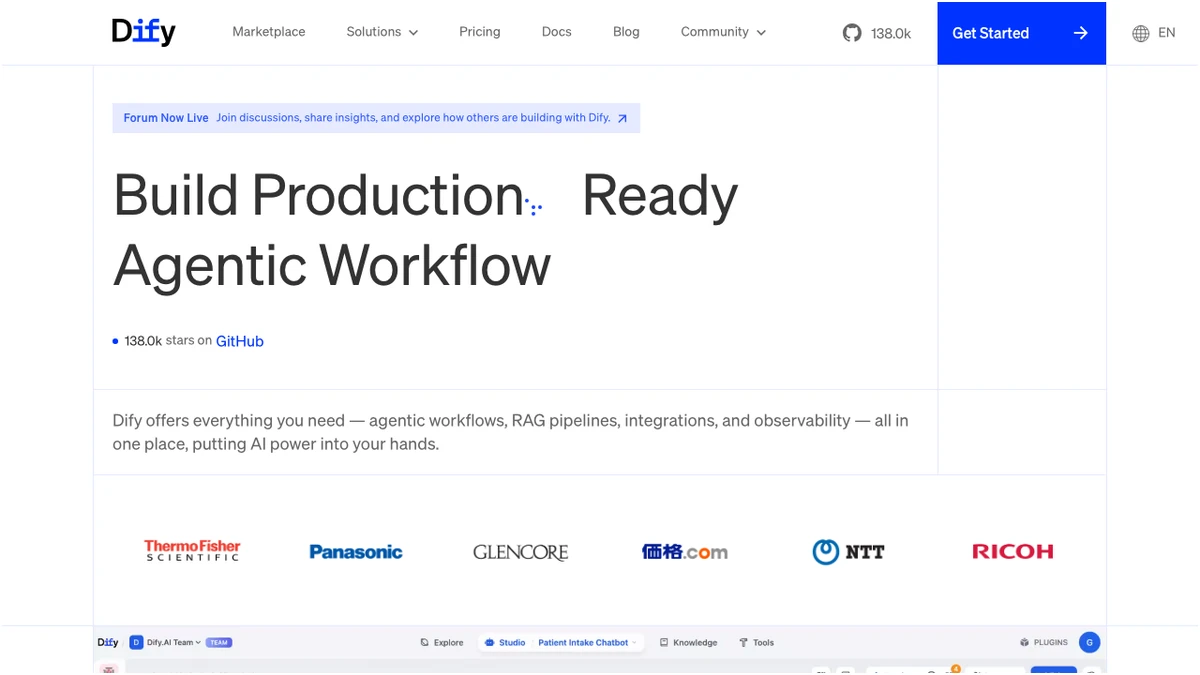
Choosing the right platform to build and deploy AI agents is critical for leveraging the power of large language models (LLMs). Two prominent contenders in this space are Dify and Flowise, each offering distinct approaches to visual agent development. Dify positions itself as a comprehensive LLMOps platform, emphasizing production readiness and scalability. Flowise, on the other hand, champions rapid prototyping with its intuitive drag-and-drop interface and deep integration with the LangChain ecosystem.
This comparison dives deep into their features, pricing, community support, and suitability for different use cases to help you make an informed decision.
Core Functionality and Features
Both Dify and Flowise provide visual interfaces for building AI applications, abstracting away much of the complexity of direct coding. However, their feature sets and underlying philosophies diverge significantly.
Dify offers a robust LLMOps platform. Its strengths lie in its built-in RAG (Retrieval Augmented Generation) pipeline, multi-agent orchestration capabilities, and production-ready observability. This makes it a strong choice for teams looking to build sophisticated, scalable AI applications that can be monitored and managed in production environments. Dify supports a wide array of models, including OpenAI, Claude, Gemini, and various open-source options, providing flexibility in model selection.
Flowise, while also capable of building complex applications, shines in its ease of use and rapid development potential. It's built on top of LangChain and LlamaIndex, allowing users to leverage the vast capabilities of these popular LLM orchestration frameworks. Its drag-and-drop interface is exceptionally intuitive, making it ideal for quickly iterating on ideas and prototyping AI agents. Flowise also supports deploying flows as REST APIs, enabling integration into existing applications.
| Feature | Dify | Flowise |
|---|---|---|
| Visual Builder | Yes | Drag-and-drop |
| LLMOps Focus | High | Moderate |
| RAG Pipeline | Built-in | Via LangChain/LlamaIndex |
| Multi-Agent Orchestration | Yes | Via LangChain |
| Observability | Production-ready | Basic |
| Model Support | OpenAI, Claude, Gemini, OSS | Any LangChain compatible |
| API Deployment | One-click endpoints | REST APIs from flows |
| Ecosystem Integration | Comprehensive | Deep LangChain/LlamaIndex |
Ease of Use and Learning Curve
For newcomers to AI agent development, the learning curve is a crucial factor. Flowise generally offers a gentler introduction. Its highly intuitive drag-and-drop interface allows users to visually connect nodes representing different LLM components, data sources, and logic. This makes it incredibly easy to get started and experiment with different agent configurations without needing to write extensive code.
Dify, while also featuring a visual builder, has a broader scope as an LLMOps platform. This means it encompasses more advanced concepts like production deployment, monitoring, and fine-tuning. While its visual builder is user-friendly, mastering the full platform, especially its production-oriented features, can involve a steeper learning curve compared to Flowise's more focused prototyping approach.
Beginner Friendliness: Flowise (5/5) vs. Dify (4/5)
Production Readiness and Scalability
When it comes to deploying AI agents into production environments, Dify demonstrates a clear advantage. Its architecture is designed with LLMOps in mind, offering robust observability features that are essential for monitoring performance, debugging issues, and ensuring reliability. The platform's multi-agent orchestration capabilities also lend themselves well to building complex, scalable AI systems. Dify's focus on production readiness means it's better equipped to handle the demands of enterprise-level applications.
Flowise is excellent for rapid prototyping and can be used for production, but it's generally considered less suited for high-demand, mission-critical production environments compared to Dify. While it offers REST API deployment, its observability features are more basic, and its architecture might require more custom engineering to achieve the same level of scalability and robustness as Dify.
Production Suitability: Dify (5/5) vs. Flowise (3/5)
Community and Development
Community support and active development are vital indicators of a tool's longevity and future potential. Dify boasts an impressive community, evidenced by its over 100,000 GitHub stars. This large and active community often translates to better documentation, more community-contributed examples, and quicker resolution of issues.
Flowise also has a growing and active community, with tens of thousands of GitHub stars. Its development is steady, with regular updates and improvements. Its tight integration with the LangChain ecosystem means it benefits from the broader community surrounding LangChain and LlamaIndex. However, Dify's larger standalone community provides a more concentrated source of support specifically for the platform itself.
Community Strength: Dify (5/5) vs. Flowise (4/5) Documentation Quality: Dify (5/5) vs. Flowise (4/5)
Pricing and Deployment Options
Both Dify and Flowise offer flexible deployment options, catering to different needs and budgets.
Self-Hosting: Both platforms are open-source (Apache 2.0 license) and can be self-hosted for free. This is a significant advantage for organizations that require full control over their data and infrastructure or wish to avoid recurring cloud costs. Dify's self-hosting typically requires Docker, while Flowise is designed to be more platform-agnostic, potentially simplifying deployment in air-gapped environments.
Cloud Offerings:
- Dify: Offers a free tier for its cloud version, with paid plans starting at $59 per month. This provides a managed experience for those who prefer not to handle infrastructure.
- Flowise: Provides a "Starter" plan at $35 per month, offering unlimited flows and a generous prediction limit, along with a "Pro" plan at $65 per month with even higher limits and unlimited workspaces.
Pros and Cons at a Glance
To summarize the key strengths and weaknesses of each platform:
Verdict: Dify vs. Flowise
The choice between Dify and Flowise hinges on your primary objective and technical maturity.
Frequently Asked Questions
Frequently Asked Questions
Sources
- https://www.xpay.sh/resources/agentic-frameworks/compare/dify-vs-flowise/
- https://anvevoice.app/faq/dify-vs-flowise
- https://www.conbersa.ai/learn/no-code-ai-builders-comparison
- https://www.youtube.com/watch?v=Fn9TXbTw56k
- https://ossinsight.io/compare/langgenius/dify/FlowiseAI/Flowise
- https://www.gumloop.com/blog/dify-alternatives
- https://sourceforge.net/software/compare/Dify-vs-Flowise/