Crewai Vs Autogen: Complete Comparison & Guide
Compare CrewAI and AutoGen in depth. Analyze features, use cases, and best practices to choose the perfect AI agent framework for your project.
8 min read
The landscape of AI agent orchestration is rapidly evolving, with frameworks like CrewAI and AutoGen emerging as frontrunners for building sophisticated, multi-agent systems. Both aim to empower developers and businesses to automate complex workflows by coordinating multiple AI agents, but they approach this challenge with distinct philosophies and feature sets. For those navigating this space, understanding the nuances between CrewAI and AutoGen is crucial for selecting the right tool to drive their automation initiatives.
This deep dive will dissect CrewAI and AutoGen, offering a data-driven comparison to help you make an informed decision. We'll examine their core functionalities, pricing structures, strengths, weaknesses, and ideal use cases.
Core Philosophies: Structured Teams vs. Free-Flowing Dialogue
At their heart, CrewAI and AutoGen represent different paradigms for agent interaction.
CrewAI is built around the concept of a "crew" – a team of AI agents with predefined roles and responsibilities, working collaboratively on a specific mission. It emphasizes structured, event-driven orchestration with a clear task order. This approach is ideal for scenarios where workflows are well-defined and require predictable execution. CrewAI leverages a Python-first approach, with options for YAML configuration and an optional Studio UI, making it accessible for those familiar with Python development. Its reliance on LangChain simplifies initial setup.
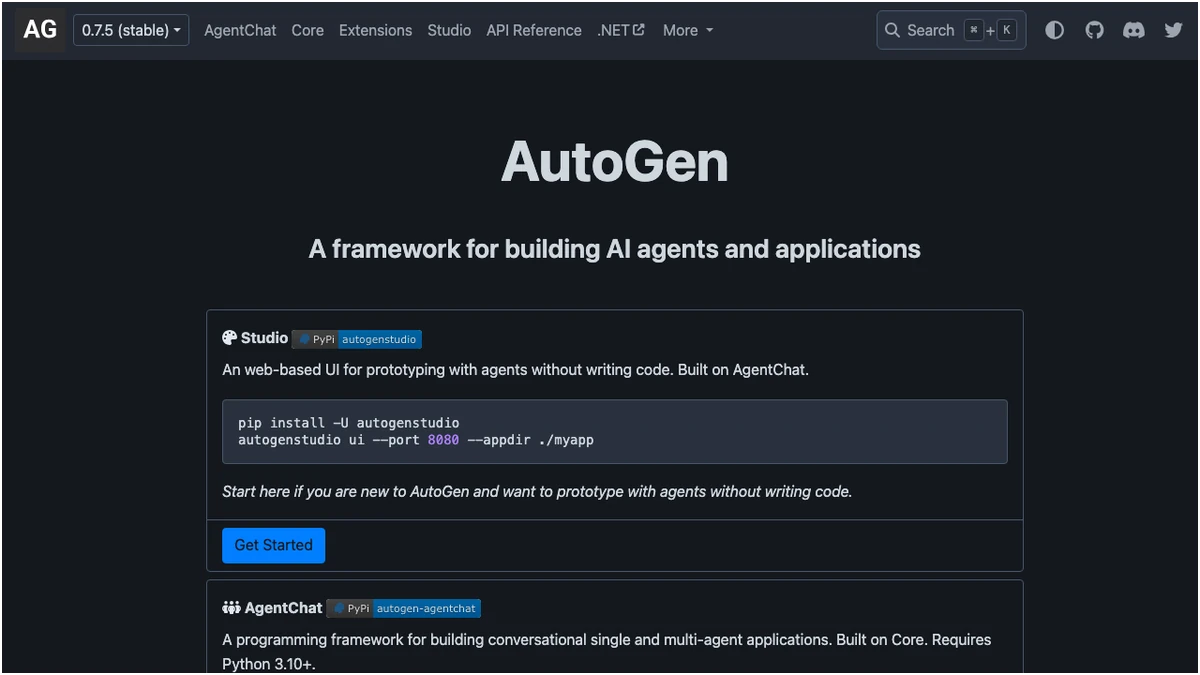
AutoGen, on the other hand, champions a more dynamic and conversational approach. Its "AgentChat" feature facilitates free-flow dialogue between agents, allowing for more emergent problem-solving and iterative refinement. This makes AutoGen particularly powerful for open-ended tasks, complex code generation, and scenarios where human intervention or real-time feedback is integral. AutoGen offers a drag-and-drop Studio alongside a comprehensive Python API, providing flexibility for various development styles. Its strength lies in its modularity and its ability to handle complex code execution within isolated Docker environments.
Feature Comparison: Orchestration, Interaction, and Customization
Both frameworks offer robust capabilities for multi-agent collaboration, but their implementations and strengths differ.
| Feature | CrewAI | AutoGen |
|---|---|---|
| Agent Orchestration | Event-driven multi-agent orchestration with preset task order. | AgentChat with free-flow dialogue coordination. |
| Development Interface | Python + YAML authoring, CLI scaffolds, optional Studio UI. | Drag-and-drop Studio + full Python API. |
| Agent Interaction Style | Scripted prompts with think-verify checkpoints. | ReAct-style self-reflection in chat loops. |
| Human-in-the-Loop | Human-in-the-loop via task pausing. | UserProxyAgent for live human input. |
| Workflow Design | Built for structured, team-based workflows. | Stronger for open-ended problem-solving and code execution. |
| Underlying Technology | Relies on LangChain; easier setup. | Modular customization for agents, tools, memory. |
| Code Execution | Supports code execution, but less emphasis on isolation. | Stronger for code execution with Docker isolation. |
CrewAI's structured approach shines in its ability to define clear roles and task sequences, making it predictable and manageable for complex, multi-step processes. The "think-verify" checkpoints offer a layer of quality control within scripted prompts. AutoGen's free-flow dialogue and ReAct-style self-reflection, however, enable agents to adapt and learn more dynamically, making it a powerful choice for tasks that require exploration and iterative refinement, especially in code generation and debugging.
Pricing Models: Open Source vs. Tiered Cloud Services
The financial implications of adopting either framework are a significant consideration.
AutoGen stands out with its entirely open-source nature. There are no paid plans for the framework itself. Costs are solely associated with the underlying infrastructure: hosting, compute resources, and the LLM APIs you choose to integrate. This offers maximum flexibility and cost control for users willing to manage their own deployments.
CrewAI offers a dual approach: an open-source core and a suite of tiered cloud plans. The open-source core is free, providing access to its fundamental agent orchestration capabilities. However, for enhanced features, scalability, and managed services, users can opt for paid plans. These plans range from a professional tier at $25/month to enterprise-level custom pricing, with intermediate options like a basic plan at $99/month for 100 executions. This tiered structure can be attractive for businesses seeking managed solutions and dedicated support, but it's important to note that the paid cloud plans can scale expensively.
Pros and Cons: Weighing the Advantages
Both frameworks bring distinct advantages and disadvantages to the table, influencing their suitability for different projects.
CrewAI's ease of use for structured tasks and its commercial support make it an attractive option for businesses prioritizing predictable workflows and dedicated assistance. However, its reliance on OpenAI and the escalating costs of its cloud tiers are points to consider. AutoGen's open-source nature, unparalleled flexibility, and strong code execution capabilities are significant draws for developers and organizations seeking deep customization and cost-effectiveness, provided they have the technical expertise to manage the infrastructure.
Recent Developments and Future Outlook
As of April 2026, both CrewAI and AutoGen continue to evolve. CrewAI maintains its dual strategy of an open-source core alongside expanding its managed cloud tiers, catering to a broader range of users from individual developers to large enterprises. AutoGen, with its strong backing from Microsoft, remains a fully open-source project, emphasizing community-driven development and broad integration capabilities. While specific major updates within the last six months are not detailed in current sources, the underlying trajectory for both frameworks points towards continued refinement in agent capabilities, tooling, and integration with the broader AI ecosystem.
Frequently Asked Questions
Frequently Asked Questions
Verdict: Which Framework Should You Choose?
The choice between CrewAI and AutoGen hinges on your project's specific requirements, your team's technical expertise, and your budget.
Sources
- https://www.lindy.ai/blog/crewai-vs-autogen
- https://www.zenml.io/blog/crewai-vs-autogen
- https://www.instinctools.com/blog/autogen-vs-langchain-vs-crewai/
- https://oxylabs.io/blog/crewai-vs-autogen
- https://www.xpay.sh/resources/agentic-frameworks/compare/crewai-vs-autogen
- https://www.datacamp.com/tutorial/crewai-vs-langgraph-vs-autogen
- https://python.plainenglish.io/autogen-vs-langgraph-vs-crewai-a-production-engineers-honest-comparison-d557b3b9262c
- https://e2b.dev/blog/crewai-vs-autogen-for-code-execution-ai-agents