Pinecone Vs Weaviate: Complete Comparison & Guide
Comparing Pinecone and Weaviate for vector search. Get detailed insights on features, pricing, and use cases to choose the perfect AI database.
9 min read
When building AI-powered applications, particularly those leveraging semantic search, recommendation engines, or Retrieval Augmented Generation (RAG), the choice of a vector database is paramount. Two prominent contenders in this space are Pinecone and Weaviate. While both offer robust solutions for storing and querying high-dimensional vectors, they approach the problem with distinct philosophies, leading to significant differences in features, flexibility, and cost. This deep dive will dissect Pinecone and Weaviate to help you make an informed decision for your specific needs.
Core Functionality: Vector Similarity Search
At their heart, both Pinecone and Weaviate are designed for efficient Approximate Nearest Neighbor (ANN) search. This means they excel at finding vectors that are "close" to a given query vector in a high-dimensional space, a fundamental operation for many AI workloads.
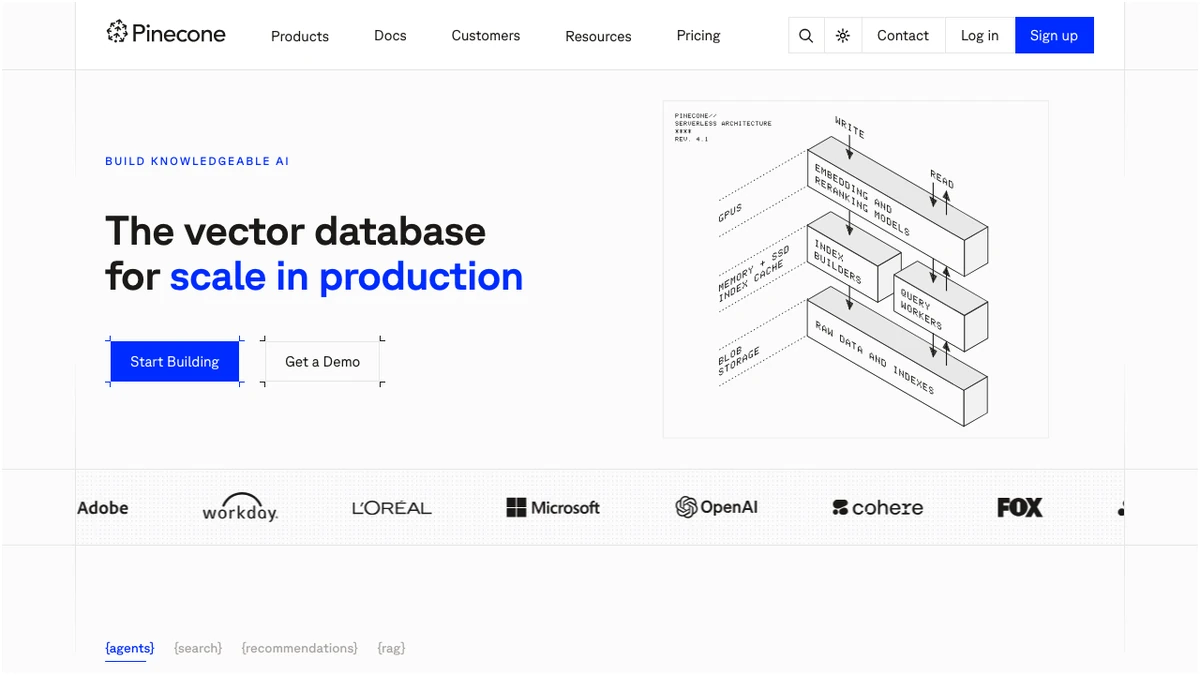
Pinecone positions itself as a fully managed, serverless vector database, emphasizing simplicity and zero operational overhead. Its architecture is built for pure vector similarity search with a focus on low-latency performance at scale.
Weaviate, on the other hand, offers a more comprehensive approach. It's an open-source vector database that can be self-hosted or used via managed cloud offerings. Weaviate goes beyond basic vector search by integrating features like built-in vectorizers, hybrid search capabilities, and a schema-rich data model.
Feature Deep Dive: Pinecone vs. Weaviate
The feature sets of Pinecone and Weaviate reveal their differing design goals. Pinecone prioritizes ease of use and pure performance for vector search, while Weaviate aims for a more feature-rich and flexible platform.
| Feature | Pinecone | Weaviate |
|---|---|---|
| Core Functionality | Vector Similarity Search (ANN) | Vector Similarity Search (ANN), Hybrid Search (Vector + Keyword) |
| Deployment Model | Fully Managed Serverless | Open-Source (Self-hosted), Managed Cloud |
| Vectorization | External (bring your own) | Built-in Vectorizers (e.g., OpenAI, Hugging Face) |
| Data Model | Vector + Metadata | Schema-rich, Vector + Rich Metadata, Generative Modules |
| API | REST API | GraphQL API, REST API |
| Multi-tenancy | Limited (via index management) | Native support |
| Scalability | Zero-ops, auto-scaling | Scalable (managed), requires configuration (self-hosted) |
| Compression/Quantization | Proprietary optimizations | Built-in (e.g., ZSTD compression, quantization) |
Pinecone's strength lies in its "zero-ops" approach. You don't manage infrastructure; you simply deploy your index and let Pinecone handle scaling and availability. This makes it incredibly easy to get started and maintain. However, this simplicity comes at the cost of flexibility. You're reliant on Pinecone's managed service and can't opt for self-hosting.
Weaviate shines in its depth and flexibility. The built-in vectorizers are a significant advantage, allowing you to ingest data and generate embeddings directly within the database, simplifying your data pipeline. Its hybrid search capability, combining vector similarity with traditional keyword search, is a standout feature for many applications that require both semantic understanding and precise term matching. The GraphQL API offers a powerful and flexible way to query your data. Furthermore, Weaviate's schema-rich data model and native multi-tenancy provide more structure and control for complex datasets.
Pricing: Understanding the Costs
The pricing models for Pinecone and Weaviate reflect their different service offerings.
Pinecone Pricing:
- Free Tier: Offers a starter free tier for initial exploration.
- Standard: This is a serverless, usage-based model. Expect around $50/month for 1 million to 50 million vectors, covering both storage and read/write units. Pricing scales linearly as your vector count increases.
- Enterprise: Custom pricing, starting from $500/month, for larger-scale deployments and dedicated support.
Weaviate Pricing:
- Free Tier: Provides a 14-day sandbox cluster for trials. Crucially, the open-source version is free to self-host, offering significant cost savings for those with the operational capacity.
- Cloud Flex/Shared: Managed cloud options start at $25-$45/month for 1 million to 50 million vectors, making it more cost-effective than Pinecone for smaller scales.
- Plus/Dedicated: Higher tiers offer enhanced performance and Service Level Agreements (SLAs) of 99.5-99.9%.
- Enterprise: Custom pricing for tailored solutions.
For smaller-scale deployments (1-10 million vectors), Weaviate's managed cloud options ($25-$45/month) are more budget-friendly than Pinecone's standard tier ($50/month). The ability to self-host Weaviate for free is a major cost advantage for organizations that can manage their own infrastructure. At larger scales, Pinecone's linear pricing can become more expensive due to a lack of volume efficiency, whereas Weaviate's managed tiers might offer better cost control, especially with features like quantization.
Pros and Cons: A Balanced View
Understanding the advantages and disadvantages of each platform is crucial for aligning with your project's goals and constraints.
Pinecone Pros:
- Simplicity and Ease of Use: Pinecone is arguably the easiest managed vector database to get started with. Its serverless nature means zero infrastructure management, allowing teams to focus on building applications rather than maintaining databases.
- Stability and Performance: It's known for its stability and consistently low-latency ANN search, especially for deployments in the 10 million to 100 million vector range, often delivering queries in under 100ms.
- Zero-Ops Scaling: Automatic scaling handles traffic spikes and growth seamlessly without manual intervention.
Pinecone Cons:
- Cost at Scale: The linear pricing model can become expensive as your vector count grows significantly. There's less inherent volume efficiency compared to some alternatives.
- Proprietary Lock-in: Being a fully managed, proprietary service means you are tied to Pinecone's ecosystem.
- No Native Hybrid Search: Pinecone focuses purely on vector similarity, lacking integrated hybrid search capabilities.
Weaviate Pros:
- Flexibility and Control: Weaviate offers the choice between free open-source self-hosting and managed cloud services, providing significant flexibility and cost control.
- Hybrid Search: Its integrated hybrid search is a major differentiator, allowing for more nuanced and powerful querying by combining vector and keyword relevance.
- Feature-Rich: Built-in vectorizers, native multi-tenancy, GraphQL API, and generative modules make it a comprehensive platform for AI applications.
- Cost Efficiency: Features like quantization and compression, along with the free self-hosting option, can lead to substantial cost savings, especially at scale.
- RAG-Friendly: The combination of hybrid search and built-in vectorizers makes it particularly well-suited for RAG architectures.
Weaviate Cons:
- Operational Complexity: Self-hosting Weaviate requires more operational expertise for setup, tuning, and maintenance compared to a fully managed service like Pinecone.
- Trial Period: The managed cloud offering has a shorter 14-day trial period for its sandbox clusters.
Recent Developments (2025-2026)
The vector database landscape is rapidly evolving. In the 2025-2026 period, both Pinecone and Weaviate have seen significant advancements:
- Weaviate: Has focused on enhancing High Availability (HA) by default in its cloud offerings, implementing advanced quantization techniques and ZSTD compression for improved storage efficiency and query performance. Observability features have also been bolstered, providing more predictable p95 and p99 latencies.
- Pinecone: Continues to refine its serverless architecture, optimizing for even lower-latency ANN search at scale and making adjustments to its usage-based pricing to better accommodate various workloads.
These updates indicate a competitive drive towards performance, efficiency, and developer experience from both providers.
Verdict: Which Vector Database is Right for You?
The choice between Pinecone and Weaviate hinges on your project's priorities, technical expertise, and budget.
Choose Pinecone if:
- Ease of Use is Paramount: You want to get up and running with minimal configuration and no infrastructure management.
- Pure Vector Search Performance: Your primary need is fast, low-latency Approximate Nearest Neighbor search.
- Managed Service is a Must: You are committed to a fully managed, serverless solution.
- Scale is Significant but Predictable: You operate at a scale where Pinecone's linear pricing is manageable, and you value its stability and performance guarantees.
Choose Weaviate if:
- Flexibility is Key: You want the option to self-host for maximum control and cost savings, or prefer a managed cloud service with competitive pricing.
- Hybrid Search is Required: Your application benefits from combining vector similarity with keyword matching.
- Integrated AI Features are Desired: You want built-in vectorizers, generative modules, or a schema-rich data model.
- Cost Optimization is a Priority: You are looking for ways to manage costs effectively, especially at scale, through features like quantization or the free self-hosting option.
- RAG Architectures: You are building RAG systems and can leverage Weaviate's comprehensive feature set.
Ultimately, both Pinecone and Weaviate are powerful vector databases. Pinecone offers a streamlined, managed experience for pure vector search, while Weaviate provides a more feature-rich, flexible, and potentially cost-effective platform with advanced capabilities like hybrid search. Carefully consider your project's specific requirements to make the optimal choice.
Sources
- https://www.buildmvpfast.com/api-costs/vector-db
- https://dzone.com/articles/pinecone-vs-weaviate-the-trade-offs-you-only-disco
- https://ranksquire.com/2026/03/04/vector-database-pricing-comparison-2026/
- https://pecollective.com/tools/pinecone-vs-weaviate/
- https://ztabs.co/compare/pinecone-vs-weaviate
- https://radar.firstaimovers.com/pinecone-vs-weaviate-comparison-2026
- https://www.firecrawl.dev/blog/best-vector-databases
- https://propelius.ai/blogs/vector-databases-compared-pinecone-weaviate-chroma/