LangChain vs CrewAI: Orchestrating Your AI Agents
Compare LangChain and CrewAI for building advanced AI agents. We analyze features, use cases, and help you choose the perfect framework.
8 min read
Choosing the right framework for building sophisticated AI agent systems is paramount. Two prominent contenders, LangChain and CrewAI, offer distinct approaches to orchestrating Large Language Models (LLMs) and their associated tools. While both aim to simplify the development of complex AI applications, they cater to different needs and development philosophies. This comparison will dissect their features, pricing, strengths, and weaknesses to help you make an informed decision.
Core Philosophies and Architectures
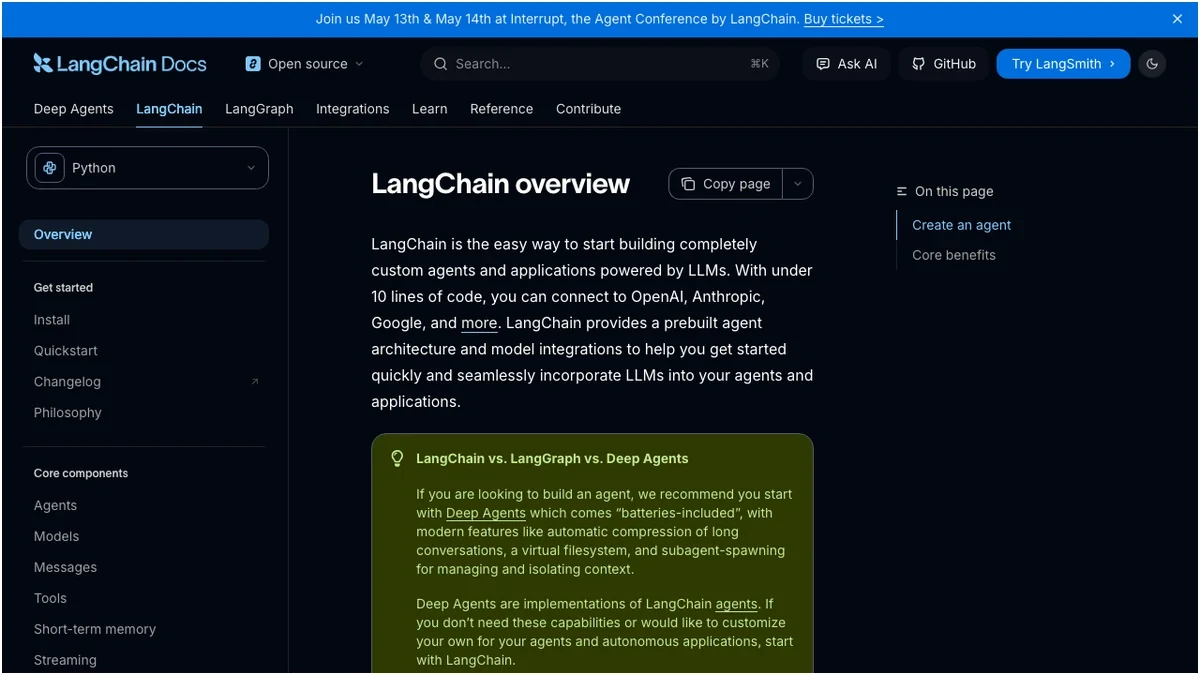
LangChain, a comprehensive LLM application development framework, provides a modular toolkit. It emphasizes flexibility and a vast ecosystem, allowing developers to chain together LLMs, data sources, and tools in virtually any configuration. Its architecture is built around the concept of "chains" and "agents," offering granular control over every step of the process.
CrewAI, on the other hand, is purpose-built for multi-agent systems. It introduces a more opinionated, yet intuitive, framework centered around the metaphor of a "crew." This crew consists of specialized agents, each with defined roles, goals, and tools, collaborating to achieve a common objective. CrewAI streamlines the creation of complex agent interactions with less boilerplate code.
Feature Deep Dive
The capabilities of LangChain and CrewAI can be best understood by examining their core features.
| Feature | LangChain | CrewAI |
|---|---|---|
| LLM Integration | Extensive support for various LLMs, model-agnostic design. | Supports major LLMs, often integrated via LangChain or direct API calls. |
| Agent Orchestration | Flexible agent creation via LangGraph, requires more manual wiring for complex multi-agent setups. | Built-in, intuitive multi-agent orchestration with role-based agents and automatic task delegation. |
| RAG Pipelines | Robust support for Retrieval Augmented Generation (RAG) with comprehensive components. | Can integrate RAG capabilities, often leveraging LangChain components for this. |
| Tool Ecosystem | Vast ecosystem with 600-700+ integrations, offering immense flexibility. | Growing tool ecosystem, with a focus on agent-specific tools and integrations. |
| Observability & Monitoring | LangSmith provides advanced production monitoring, tracing, and debugging. | CrewAI+ dashboard offers monitoring and management for crews and agents. |
| Extensibility | Highly extensible due to its modular design and open-source nature. | Extensible, particularly through its Flows and custom tool development. |
| Learning Curve | Moderate to steep due to its extensive API and broad capabilities. | Moderate, generally considered easier for multi-agent setups due to its focused metaphor. |
LangChain's strength lies in its comprehensive toolkit. It's not just about agents; it's a full LLM application development framework that includes robust support for RAG pipelines, complex chains, and a staggering number of integrations. This makes it incredibly versatile for building a wide array of AI applications beyond just agentic systems.
CrewAI, conversely, excels in its specialized domain: multi-agent orchestration. Its "crew" metaphor simplifies the setup of collaborative agents. Agents are defined with clear roles, backstories, and goals, and the framework handles the delegation and execution of tasks among them. This focus makes it significantly faster to get a multi-agent system up and running.
Pricing Models
Both frameworks offer open-source core libraries, but their enterprise and managed services come with different pricing structures.
LangChain's open-source core is completely free, and its observability platform, LangSmith, offers a generous free tier for smaller projects. Paid tiers for LangSmith are per-seat, making them scalable for teams.
CrewAI's open-source core is also free. However, its paid tiers, starting at $40-$99/month, are based on execution counts. This can be a more predictable cost for high-volume agent operations but might become expensive for very large-scale deployments if not managed carefully. CrewAI+ offers more advanced features and higher limits at a higher price point.
Pros and Cons
Understanding the advantages and disadvantages of each framework is crucial for aligning them with your project requirements.
LangChain's vast ecosystem and flexibility are its superpowers. If you need to integrate with a wide array of services or require fine-grained control over every aspect of your LLM application, LangChain is an excellent choice. Its mature observability platform, LangSmith, is a significant advantage for production deployments.
CrewAI shines when the primary goal is building sophisticated multi-agent systems quickly. Its intuitive design reduces the complexity of orchestrating multiple agents, allowing developers to focus on agent behavior and collaboration rather than the underlying infrastructure.
When to Choose Which
The decision between LangChain and CrewAI hinges on your project's specific needs and your team's expertise.
Choose LangChain if:
- You need maximum flexibility and control over your LLM application architecture.
- Your project involves complex RAG pipelines, custom chains, or a wide variety of LLM integrations.
- You require a mature and robust observability and debugging platform for production environments.
- You are building a broad range of LLM applications, not solely focused on multi-agent systems.
- You have the development resources to manage a more extensive API and potentially more manual configuration.
Choose CrewAI if:
- Your primary focus is building multi-agent systems with clear roles and collaborative tasks.
- You want to rapidly prototype and deploy agentic workflows with minimal boilerplate.
- You value an intuitive and opinionated framework that simplifies agent orchestration.
- The built-in agent collaboration features align well with your project's requirements.
- You are comfortable with a slightly smaller, though growing, ecosystem.
Can You Use Them Together?
Absolutely. The power of these frameworks isn't mutually exclusive. A common and effective pattern is to use CrewAI for high-level multi-agent orchestration and LangChain for specific functionalities within individual agents. For instance, an agent within a CrewAI system might leverage LangChain's robust RAG capabilities or its extensive tool integrations to perform its assigned tasks. This hybrid approach allows you to benefit from CrewAI's ease of multi-agent setup while tapping into LangChain's vast toolkit for specialized functions.
Frequently Asked Questions
Frequently Asked Questions
Verdict
Ultimately, the choice between LangChain and CrewAI depends on your project's specific requirements and your team's priorities. For rapid development of multi-agent systems, CrewAI offers a streamlined and intuitive experience. For maximum flexibility, a vast ecosystem, and comprehensive LLM application development capabilities, LangChain remains the go-to choice. Many advanced projects will likely find value in combining the strengths of both.