Langchain vs LlamaIndex: Which AI Framework is Right for You?
Comparing LangChain and LlamaIndex? Understand the core differences, use cases, and best practices to select the perfect AI framework for your application.
8 min read
The landscape of Large Language Model (LLM) application development is rapidly evolving, with frameworks like LangChain and LlamaIndex at the forefront. Both aim to simplify the creation of sophisticated AI-powered applications, but they approach the problem with distinct philosophies and feature sets. As of 2026, understanding their core strengths and weaknesses is crucial for developers and businesses looking to leverage LLMs effectively, particularly for Retrieval Augmented Generation (RAG) and complex workflow orchestration.
At its heart, the choice between LangChain and LlamaIndex often boils down to your primary use case: are you building a robust, multi-step agentic system with intricate logic, or are you focused on efficiently ingesting, indexing, and retrieving information from your own data to power LLM responses?
Core Philosophies: Orchestration vs. Indexing
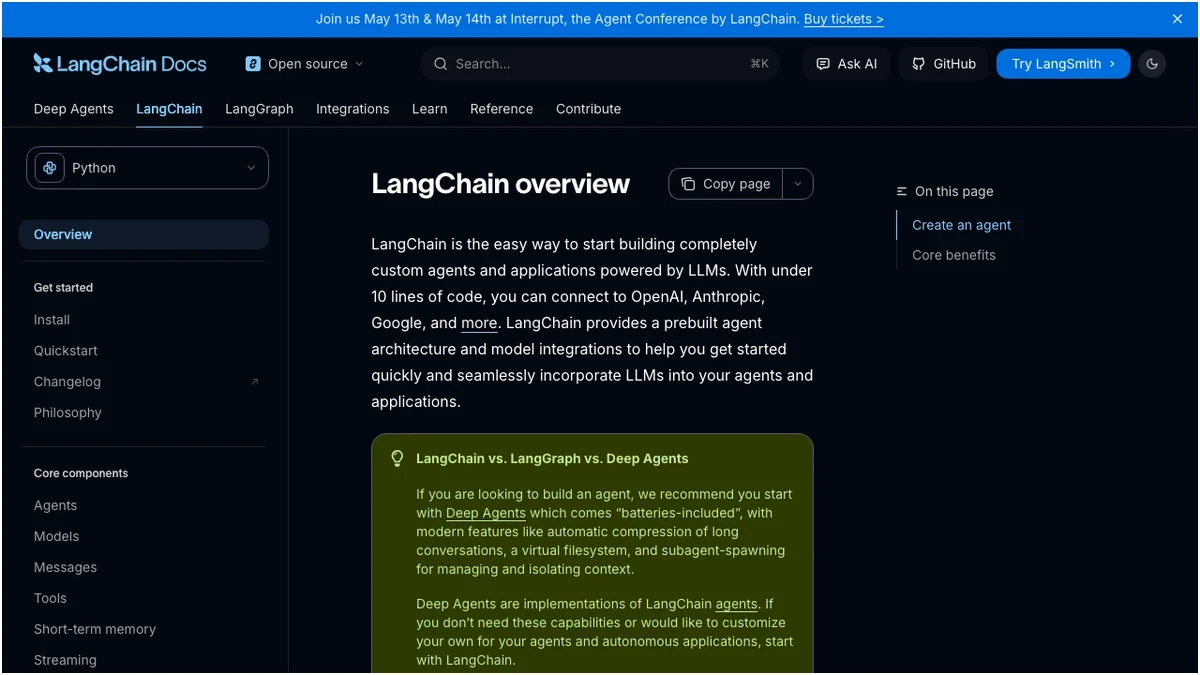
The fundamental difference lies in their design priorities. LangChain excels at orchestration and multi-step workflows. It provides a modular architecture that allows developers to chain together LLM calls, data retrieval, and custom logic to create complex agents capable of reasoning and acting. Its strength lies in its flexibility and granular control over how different components interact.
LlamaIndex, on the other hand, is purpose-built for document indexing and retrieval optimization. Its primary goal is to make it seamless to connect LLMs with your private data. It offers advanced techniques for ingesting, structuring, and querying large volumes of unstructured data, significantly enhancing the performance and accuracy of RAG applications.
Feature Deep Dive: LangChain vs. LlamaIndex
To illustrate their differences, let's break down key features:
| Feature | LangChain | LlamaIndex |
|---|---|---|
| Core Functionality | Multi-step workflows, agent orchestration, LLM chaining, memory management. | Document indexing, data ingestion, retrieval optimization for RAG. |
| Data Handling | Integrates with various data sources, but retrieval is not its primary optimization focus. | Supports 160+ data formats, optimized for efficient ingestion and indexing of diverse data. |
| Retrieval Performance | Standard retrieval speeds, requires manual tuning for optimal performance. | 40% faster retrieval, 35% boost in retrieval accuracy (as of 2025 benchmarks). |
| Workflow Complexity | Highly flexible for complex, multi-agent systems and intricate reasoning chains. | Primarily focused on RAG pipelines; less emphasis on complex agent orchestration. |
| Learning Curve | Steeper due to its extensive modularity and focus on granular control. | Gentler learning curve, especially for RAG-focused applications. |
| Customization | Extensive customization options for every stage of the workflow. | Strong customization within indexing and retrieval; less so for broader orchestration. |
| Recent Innovations (2025) | LangGraph introduced for enhanced workflow control in complex reasoning. | Cloud-based LlamaParse with usage pricing; significant retrieval accuracy improvements. |
LangChain: The Orchestrator's Toolkit
LangChain's modular architecture is its superpower. It allows developers to construct sophisticated LLM applications by piecing together various components: LLMs, prompt templates, output parsers, retrievers, memory modules, and agents. This makes it ideal for scenarios requiring complex decision-making processes, multi-turn conversations with persistent memory, or agents that can interact with external tools and APIs.
Its recent introduction of LangGraph further solidifies its position for complex reasoning tasks. LangGraph enables the creation of stateful, multi-agent applications that can execute complex workflows, making it a powerful choice for advanced AI agents. The framework's extensive integrations and large community support (over 117k GitHub stars) also contribute to its enterprise readiness and scalability.
However, this power comes with a trade-off: a steeper learning curve. Developers need to understand how to effectively combine and tune these modules to achieve optimal results, especially for retrieval-augmented generation where manual tuning might be necessary.
LlamaIndex: The RAG Specialist
LlamaIndex shines when your primary goal is to build applications that intelligently query your own data. It offers an impressive array of features specifically designed to optimize the RAG pipeline. With support for over 160 data formats and advanced parsing capabilities through LlamaParse, it can ingest and index virtually any type of document.
The framework's key differentiator is its focus on retrieval performance. Benchmarks from 2025 indicate a 40% improvement in retrieval speed and a 35% boost in accuracy. This is achieved through sophisticated indexing strategies and optimized query engines that understand context-aware relationships within your data. For developers building chatbots, Q&A systems, or knowledge management tools powered by private datasets, LlamaIndex offers a significantly more streamlined and performant solution out-of-the-box.
While LlamaIndex is excellent for RAG, its flexibility for complex agent orchestration is less pronounced compared to LangChain. Its structure is more geared towards data-centric LLM applications.
Pricing Models: Open Source vs. Usage-Based
Understanding the pricing models is critical for budgeting and scalability.
LangChain's core libraries are entirely open-source and free under the MIT license. This offers unparalleled flexibility and cost-effectiveness for developers who can manage their own infrastructure. Paid tiers exist for services like LangSmith (for monitoring and debugging) and LangGraph (for advanced workflow control), but the foundational framework remains free.
LlamaIndex offers a more structured, usage-based pricing model for its cloud services, including LlamaParse. While a free tier is available with limited credits and resources, scaling up incurs costs. The pricing is based on credits, where 1,000 credits equate to $1.25. This model can be predictable for smaller projects but might introduce cost variability and concerns for very large-scale deployments if not managed carefully.
Pros and Cons at a Glance
Can They Be Used Together?
Absolutely. The most powerful approach often involves leveraging the strengths of both frameworks. You can use LlamaIndex for its superior document ingestion, indexing, and retrieval capabilities to build a highly efficient knowledge base. Then, you can integrate this optimized retrieval system into a LangChain application for orchestration, agent logic, and complex workflow management. This hybrid approach allows you to benefit from LlamaIndex's RAG performance while utilizing LangChain's flexibility for building sophisticated AI agents.
Verdict: Which Framework is Right for You?
As of 2026, the choice between LangChain and LlamaIndex is clearer than ever. If your core requirement is to build robust, data-intensive RAG applications with top-tier retrieval performance and a smoother onboarding experience for that specific task, LlamaIndex is the standout choice. Its specialized focus on indexing and retrieval makes it incredibly efficient for querying private datasets.
Conversely, if your ambition extends to creating sophisticated AI agents, multi-step reasoning engines, or complex conversational systems that require deep integration and orchestration of various LLM components and external tools, LangChain remains the more versatile and powerful option. Its modularity and the recent advancements with LangGraph empower developers to build highly customized and complex AI architectures.
For many advanced use cases, the optimal solution might be a synergistic combination of both, where LlamaIndex handles the data retrieval backbone and LangChain orchestrates the overall application logic.
Sources
- https://www.xpay.sh/resources/agentic-frameworks/compare/langchain-vs-llamaindex/
- https://latenode.com/blog/platform-comparisons-alternatives/automation-platform-comparisons/langchain-vs-llamaindex-2025-complete-rag-framework-comparison
- https://www.llamaindex.ai/pricing
- https://www.ibm.com/think/topics/llamaindex-vs-langchain
- https://www.datacamp.com/blog/langchain-vs-llamaindex
- https://contabo.com/blog/llamaindex-vs-langchain-which-one-to-choose-in-2026/
- https://www.databasemart.com/blog/langchain-vs-llamaindex
- https://coworker.ai/blog/langchain-vs-llamaindex