OpenRouter vs Together AI: Which API is Right for You?
Comparing OpenRouter and Together AI for your app. See how they stack up on model access, latency, pricing, and why developers choose one over the other.
7 min read
Choosing the right Large Language Model (LLM) API provider is a critical decision for any AI-powered application. Two prominent players in this space, OpenRouter and Together AI, offer distinct approaches to accessing a vast array of models. While both aim to democratize LLM access, their feature sets, pricing structures, and underlying philosophies cater to different user needs. This deep dive will dissect OpenRouter and Together AI, providing the data-driven insights you need to make an informed choice.
Core Offerings: Unified Access vs. AI-Native Cloud
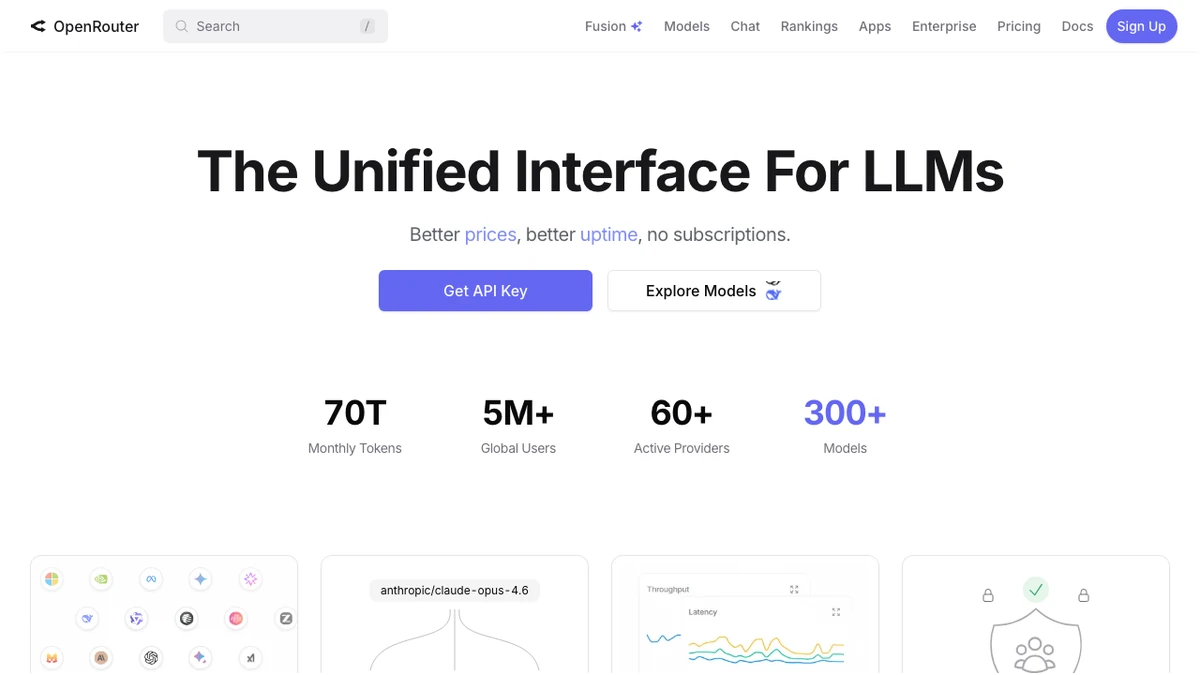
At their heart, OpenRouter and Together AI tackle LLM access from different angles. OpenRouter positions itself as a unified API gateway, aiming to consolidate hundreds of models from various providers under a single, consistent interface. This approach prioritizes breadth and ease of switching between models without significant code refactoring.
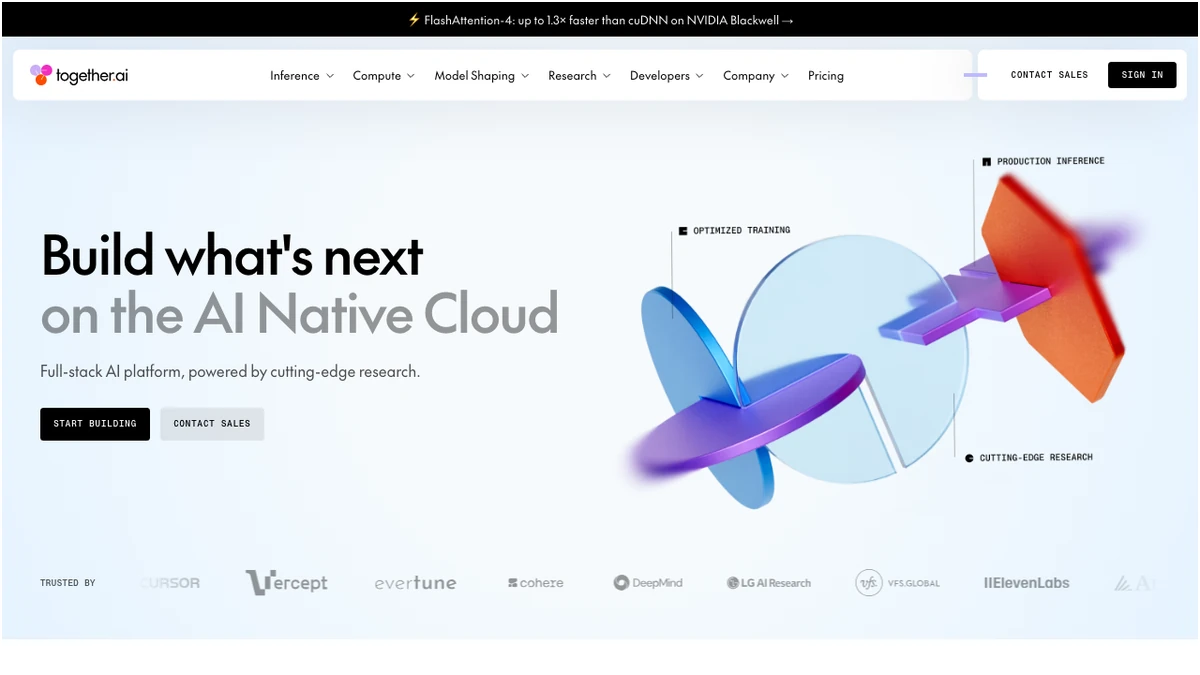
Together AI, on the other hand, presents itself as an AI-native cloud platform. Their focus is on providing a robust, scalable infrastructure for training, fine-tuning, and inferencing on GPU clusters, with a curated selection of high-performance open-source models. They emphasize optimization for massive scale and seamless integration without the burden of infrastructure management.
Feature Showdown: What Sets Them Apart?
The divergence in their core offerings translates into distinct feature sets. OpenRouter's strength lies in its comprehensive model catalog and intelligent routing capabilities. It boasts an impressive 319 models from a multitude of providers, allowing users to fetch model details, pricing, and limits directly via API. Its automatic routing, load-balancing, and fallback mechanisms are designed to ensure high uptime and resilience, a crucial factor for production environments. Customizable provider preferences add another layer of control.
| Feature | OpenRouter | Together AI |
|---|---|---|
| Model Count | 319 | 173 |
| API Unification | Yes, single API for all models | No, model-specific endpoints or flexible switching |
| Automatic Routing/Load Balancing | Yes | No |
| Training/Fine-tuning Support | No | Yes, on GPU clusters |
| Infrastructure Management | Abstracted | Abstracted |
| Model Discovery (API) | Yes | Limited |
| Latest Open Models | Curated list | Auto-updated |
Together AI's platform is built for performance and scale. While it offers a more focused selection of 173 models, these are often the latest and most performant open-source options, automatically updated. Their infrastructure is optimized for trillions of tokens, making them a compelling choice for applications demanding high throughput and low latency at scale. The ease of API integration and flexible model switching, coupled with the absence of vendor lock-in, are significant advantages.
Pricing Deep Dive: Cost-Effectiveness at Different Scales
Pricing is often a deciding factor, and here, both OpenRouter and Together AI offer competitive, pay-as-you-go token-based models. However, nuances exist.
OpenRouter operates on a prepaid credit system, where you load credits and pay per token. Their pricing is transparent per model, but it's important to note that they may apply an additional loading fee on closed-source models (like those from OpenAI or Anthropic), making direct API access potentially cheaper for those specific models. For many open-source models, OpenRouter offers competitive rates, and it's particularly cheaper on "42/86 shared models."
Together AI also uses a token-based, pay-as-you-go model. Their pricing is generally competitive, especially when compared to proprietary APIs. They are noted as being cheaper on "34/86 shared models." While they don't explicitly list pricing for every model publicly in the same way OpenRouter does, their focus on hardware optimization suggests cost-efficiency at scale.
The FAQ section highlights that the "cheaper overall" question depends heavily on the specific models you intend to use. OpenRouter has an edge on some shared models, while Together AI leads on others, with a significant number being priced identically.
Pros and Cons: A Balanced Perspective
To crystallize the decision-making process, let's summarize the key advantages and disadvantages of each platform.
OpenRouter's primary draw is its unified API, offering access to a vast ecosystem of models. Its built-in reliability features and transparent pricing for each model are significant benefits. However, users might experience higher latency compared to direct API calls, and the additional fees on closed models can be a drawback. Less control over the underlying infrastructure is also a consideration.
Together AI shines with its AI-native infrastructure, eliminating the need for users to manage GPUs. The automatic updating of the latest open models and its cost-efficiency at scale are compelling. Its ease of integration and lack of vendor lock-in are also strong points. The main limitations are a smaller model catalog compared to OpenRouter and the potential for significant price variations between models.
Recent Developments and Future Outlook
As of April 2026, both platforms continue to evolve. While no major product overhauls have been documented in the last six months (since October 2025), the landscape of available models is constantly expanding. Recent additions to both catalogs include newer iterations of popular series l ike Gemma 3/4, GLM 4.5-5.1, and Qwen3.5. The pricing dynamics remain a key differentiator, with OpenRouter holding an advantage on certain shared models and Together AI on others, underscoring the importance of specific model usage in cost calculations.
Verdict: Which LLM API is Right for You?
The choice between OpenRouter and Together AI hinges on your project's specific requirements and priorities.
For developers prioritizing breadth of choice and API simplicity, OpenRouter stands out. Its unified interface and intelligent routing make it an excellent choice for rapid prototyping, A/B testing different models, and ensuring application uptime.
Conversely, if your focus is on cutting-edge open-source models, high-performance inference, and the flexibility to train or fine-tune, Together AI offers a more specialized and powerful platform. Its AI-native infrastructure is designed for demanding workloads and scalable AI development.
Ultimately, the best way to decide is to test both platforms with your specific use cases, paying close attention to model performance, latency, and the pricing of the models you intend to deploy.
Try These Tools
Try OpenAI API Try Claude APISources
- https://pricepertoken.com/endpoints/compare/openrouter-vs-together
- https://aiindigo.com/compare/openrouter-vs-together-ai
- https://sourceforge.net/software/compare/OpenRouter-vs-Together-AI/
- https://news.ycombinator.com/item?id=41449621
- https://github.com/orgs/langfuse/discussions/3559
- https://openrouter.ai/models